SORTA AI · 2025
— Built on one thesis: AI should reduce the decisions you need to make, not add a new interface to manage.
Role
Founding Designer
TEAM
Team of 4
stage
pre-seed
duration
6 months
What I did here
my focus
Stakeholder alignment
Turned 3 founders + 40+ competing ideas into one shared decision foundation — in two sessions
Pre-build trust validation
Tested user trust in AI guidance before a single screen was designed
Feature prioritization
Protected two engineers from scope creep by defining exactly what shipped and what waited
the outcome
One clear product direction, team aligned, shipped in 8 weeks.
The situation
The team had been researching for months. The more we learned, the less we agreed on what to build.
The problem wasn't lack of research — it was lack of constraint. After weeks of research, we are lost. Every meeting produced more ideas, not fewer.
I made the call to stop expanding the problem and start constraining it.
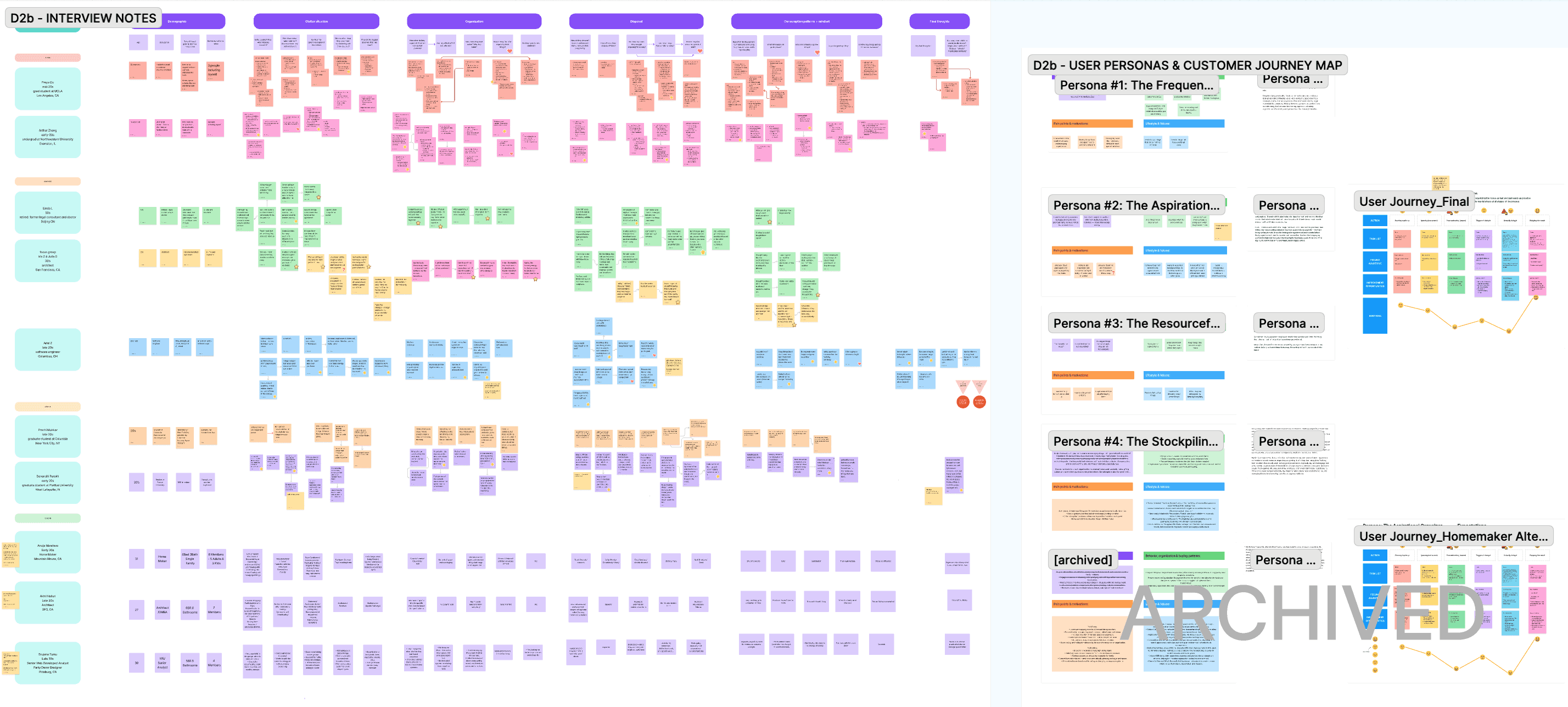
A peep into the research rabbit hole we were in
the constraint
I gave every founder 20 minutes and three circles to define the entire product.
Who has the problem? What it is? What do we provide? The limited space in this molecule model forced the team to cut vague thinking and get to the core.
— after some discussion and voting, we finally aligned on one version.
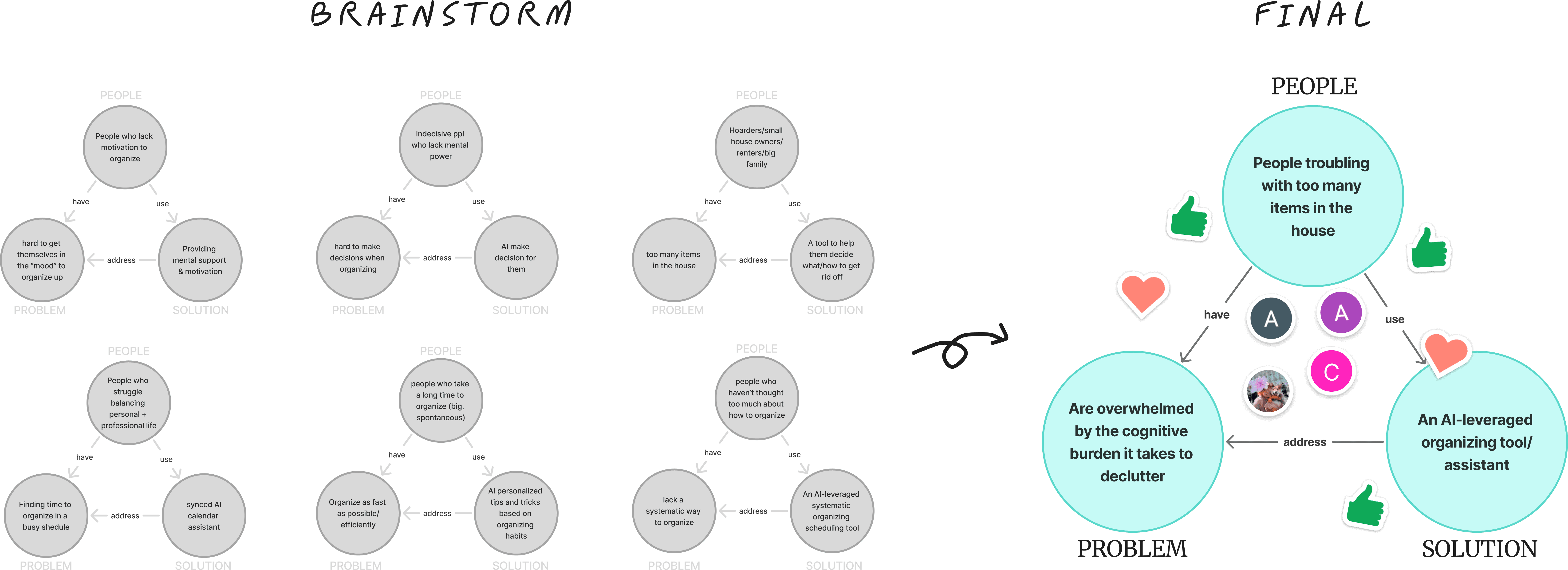
Synthesizing what people have in mind into the molecule, then align on one. No looking back.
the reframe
Alignment exposed the real problem: this wasn't about clutter. It was about decision fatigue.
Clutter is visible. The actual blocker is the mental weight of deciding what to do with it — and that's what nobody had named yet. Once we saw that, the product question changed completely: if cognitive overload is the problem, what should AI actually do?
And we now face two directions:
Option A — AI as agent
remove physical effort
significant building cost
no user control
Option B — AI as companion
reduce mental effort
low building cost
preserve user control
We chose option B — AI not as a doer, but as a companion.
The technology wasn't there for full automation, and more importantly, our users don't actually want someone to finish the task for them. They want a buddy doubler: something that reduces the mental weight of deciding while keeping the sense of accomplishment intact.
designing sortie
AI companion needs a personality. Sortie wasn't decoration — it was a product strategy decision.
We want the app to feel approachable and emotionally aware, they stay in control and keep coming back. Sortie's character — the tone, the warmth, the way it handles emotional attachment to objects — was designed to make the AI feel like it's on your side, not managing you.
Decluttering companion: Sortie
The team created this mascot to build rapport between the product and the users.
Sortie reframes the product from a tool that gives instructions to a companion that reduces stress.
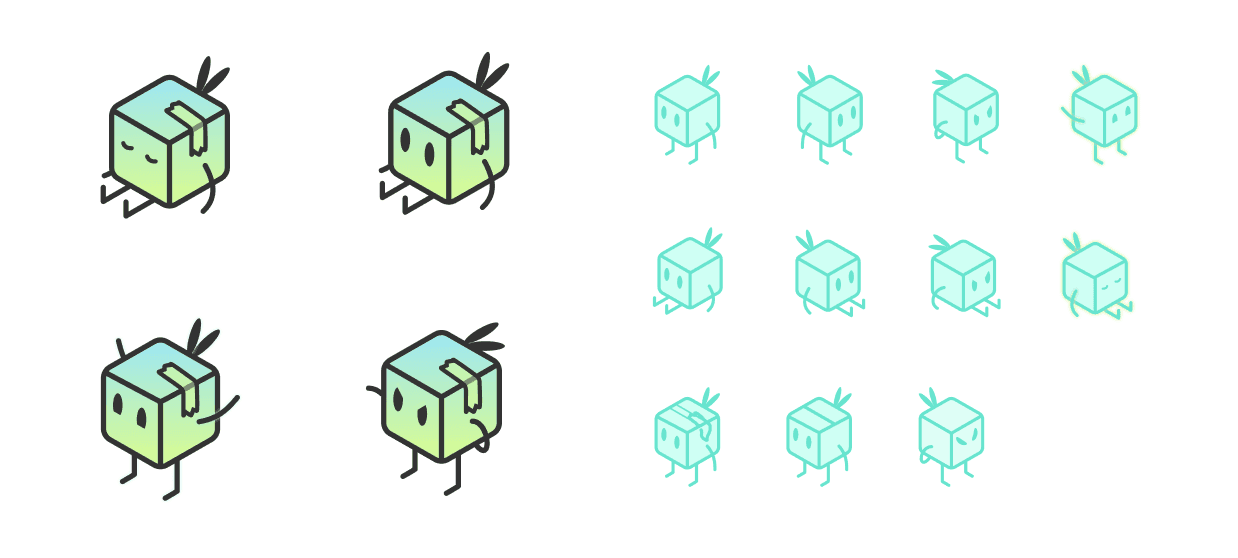
Sortie's original sketches
We want the app to feel approachable and emotionally aware, they stay in control and keep coming back. Sortie's character — the tone, the warmth, the way it handles emotional attachment to objects — was designed to make the AI feel like it's on your side, not managing you.
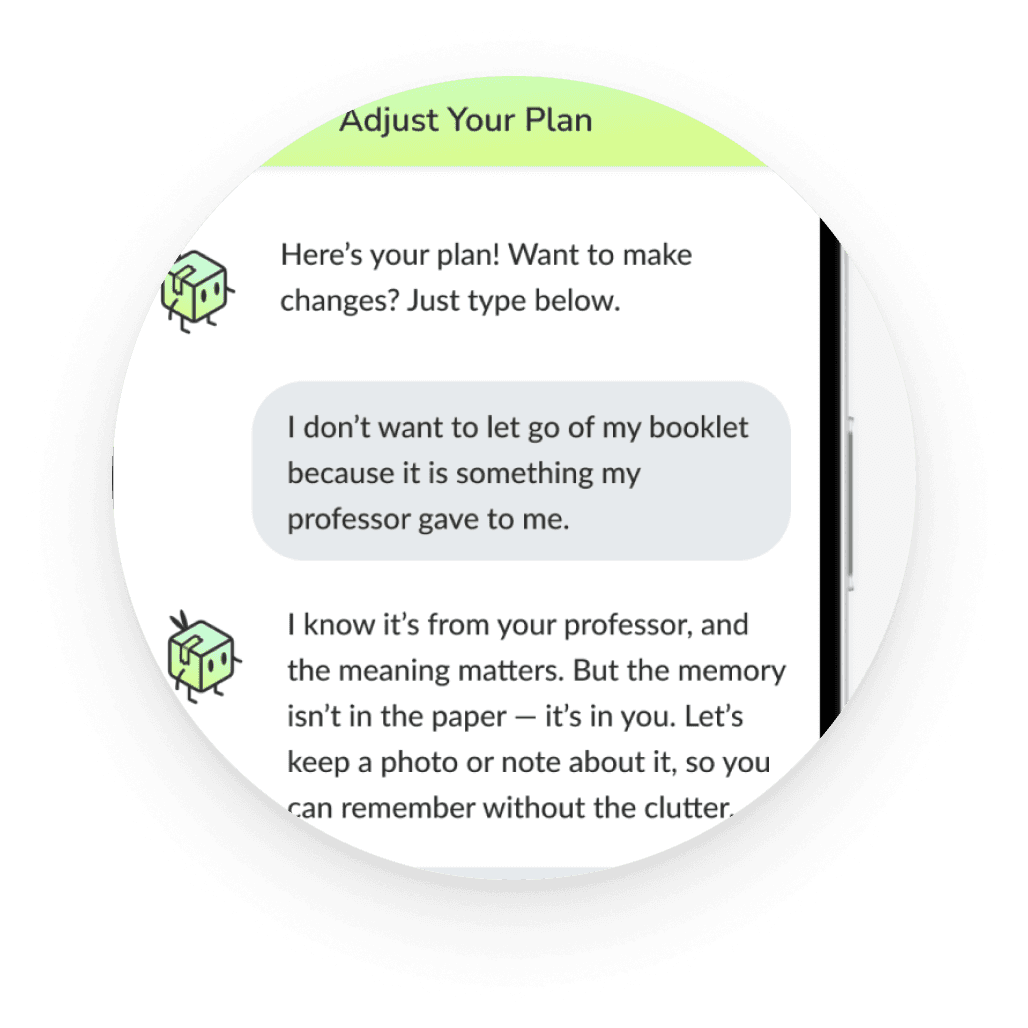
the product
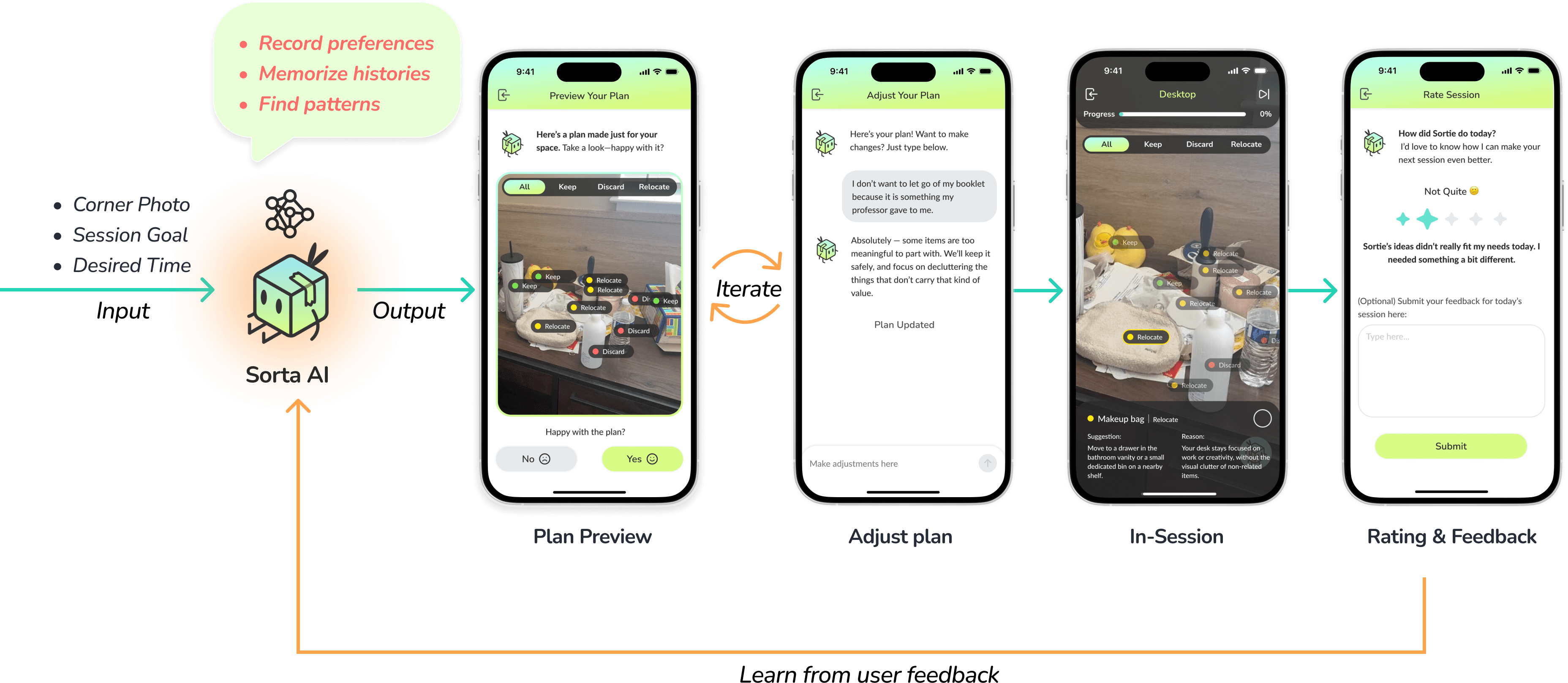
Sortie doesn't tell you what to do. It learns how you think — and gets better over time.
We built a core feedback loop: What you skip, where you slow down, what you can't let go of — Sortie records all of it. The next session starts smarter than the last.
feature prioritization
Does this reduce cognitive load or save time? If not, don't ship.
Two engineers, no room for the full vision. I scoped the MVP to one job: help users make decisions with less mental burden. Everything else — smart home integrations, resale platforms, circular economy automation — got cut.
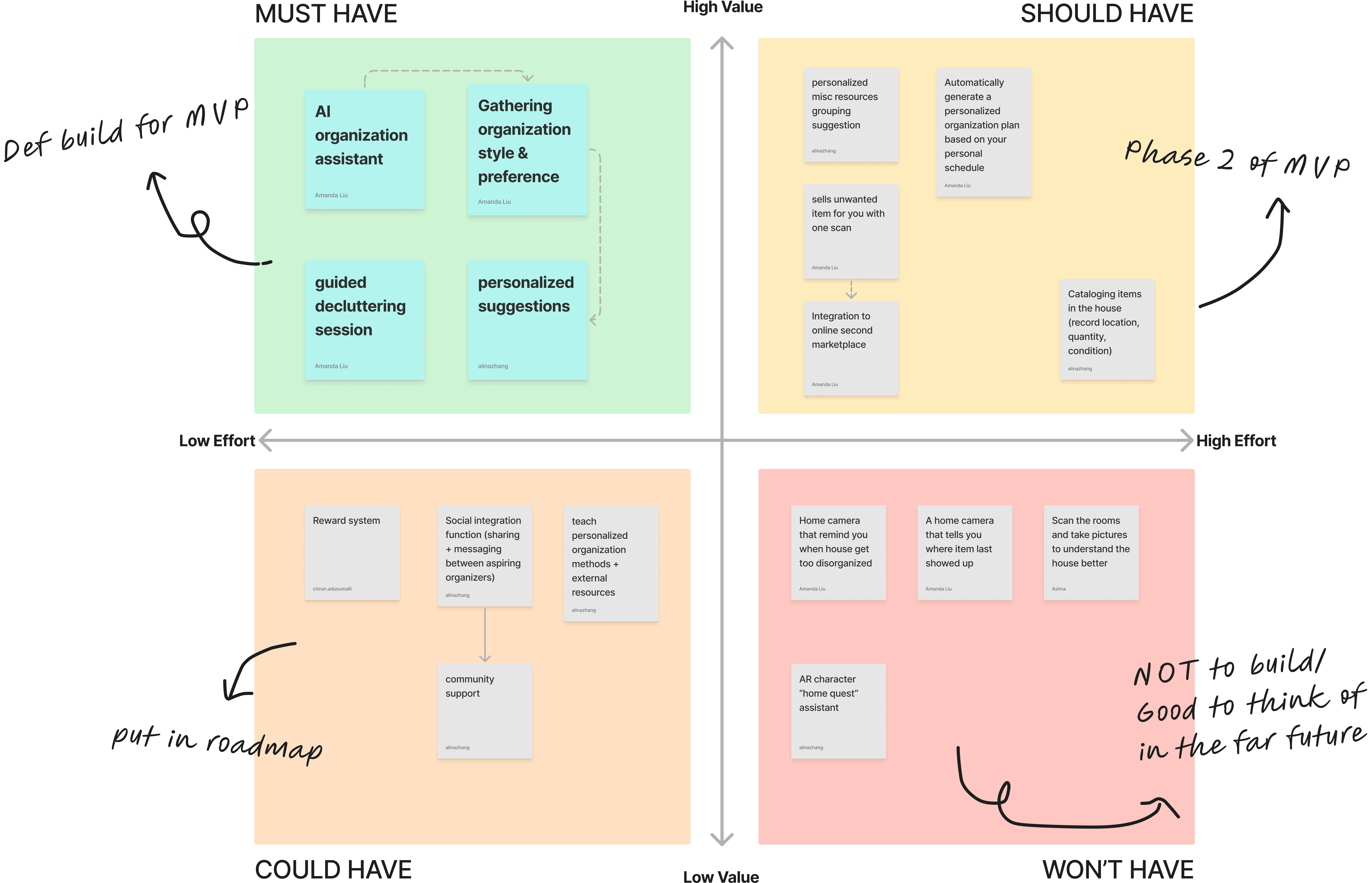
MoSCoW defines what to build NOW, LATER or NEVER
the vision
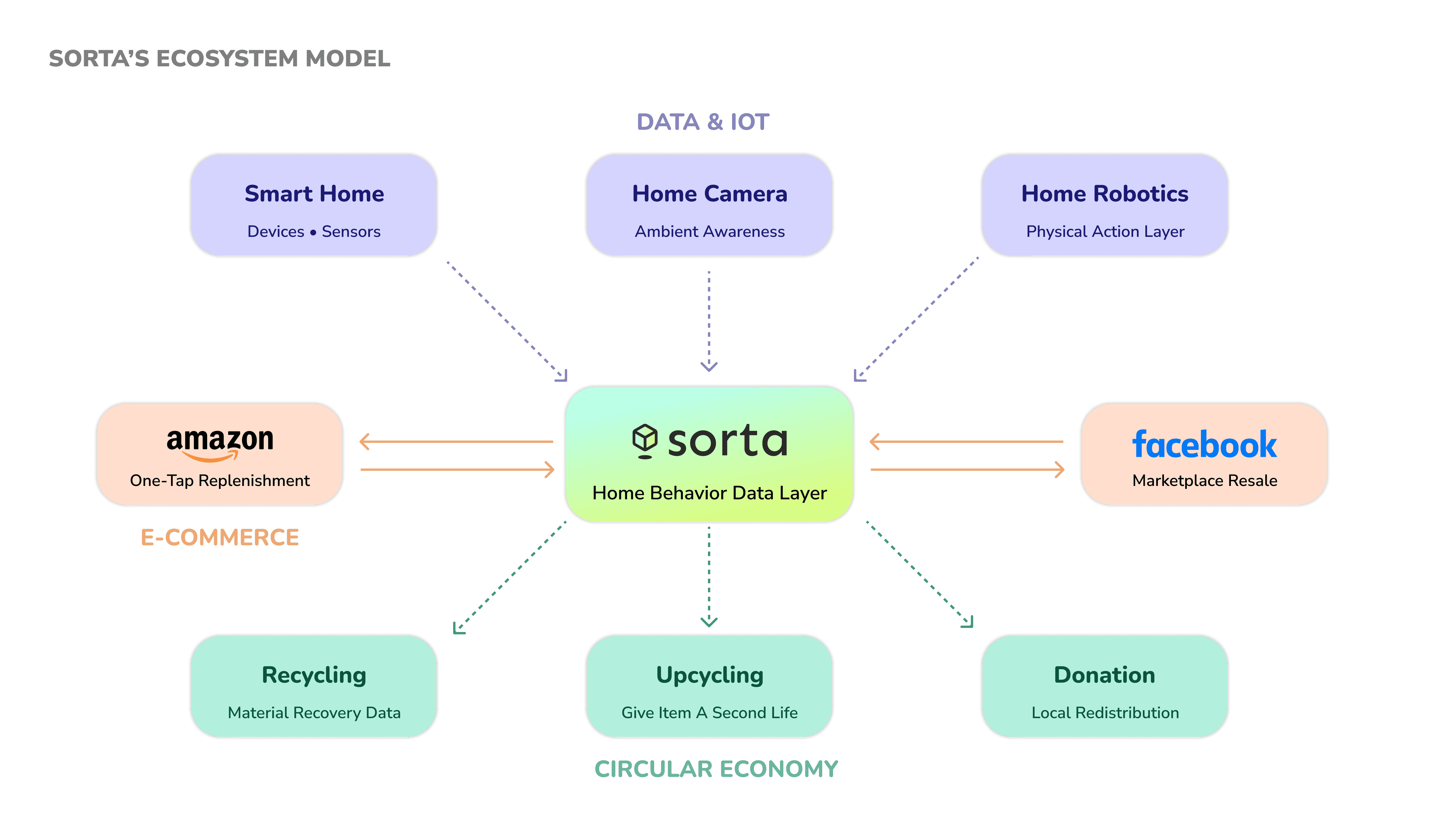
Overtime, Sorta becomes the behavior data layer that serves as a brain to the smart home ecosystem.
That layer is what makes each connection meaningful: Amazon becomes a replenishment engine that knows your consumption rhythm. Facebook Marketplace routes the right item to the right buyer at the right moment. Recycling and donation networks close the material loop with real household context. The decluttering app is the entry point.
The home behavior data layer is the product.